
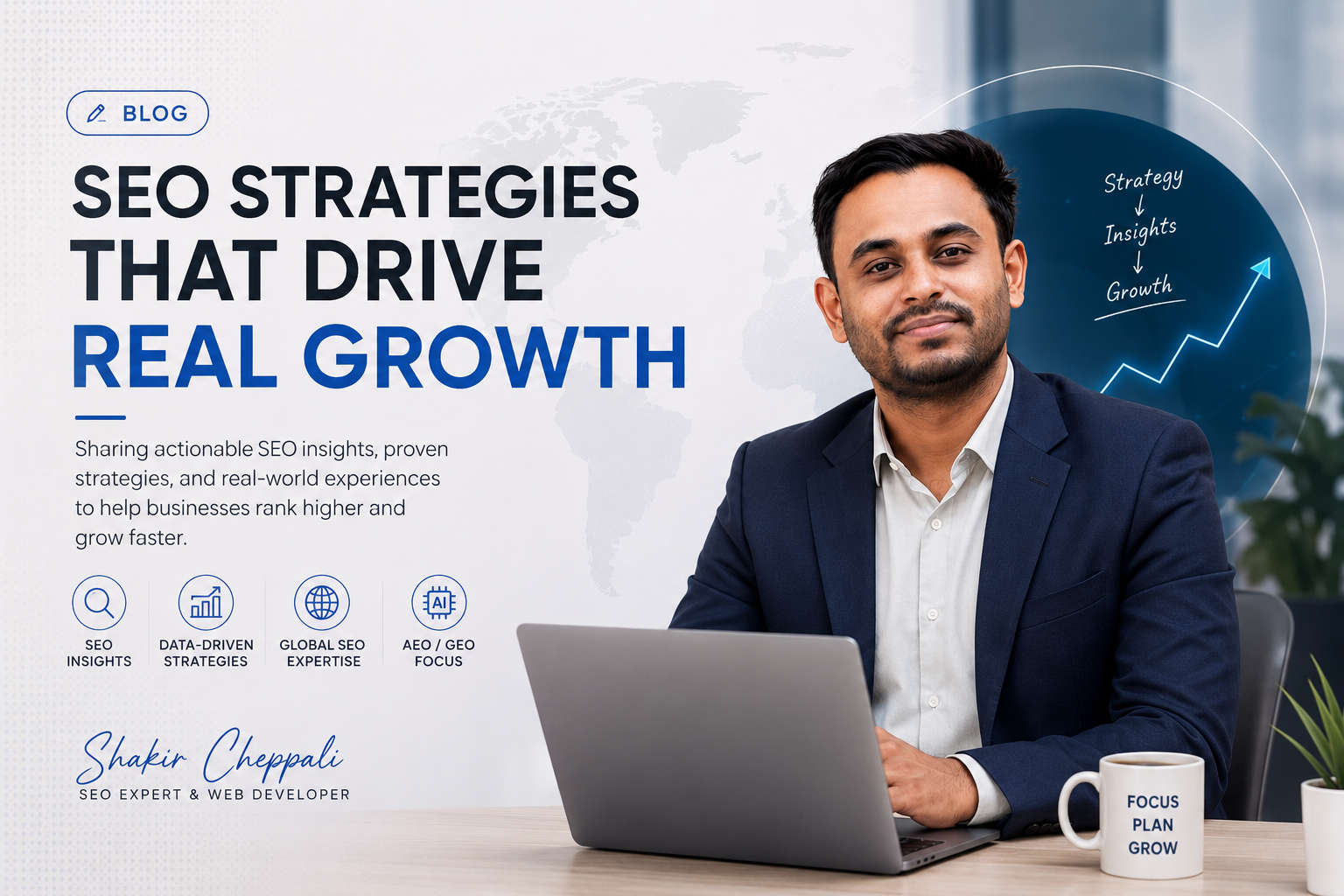
I still remember the exact moment I realized SEO wasn't just a skill — it was a responsibility.
It was 2016. I'd just started as a Junior SEO Analyst at Adox Solutions Pvt Ltd, and a client's rankings dropped overnight. Not a slow slide — an overnight cliff. Watching that unfold from the inside, I understood something no course had told me: behind every keyword, every ranking position, every "organic traffic" line on a dashboard, there's a real business whose customers depend on strangers finding them on Google. I've never forgotten that. Nine years later, I still haven't.
This setup is based on years of enterprise SEO experience. While this will be the standard flow for most websites, there may be minor changes required depending on your specific CMS or tech stack.
Where It Actually Started
I didn't start out with a big title or a finished skill set. I started at a desk inside Adox Solutions, with a lot more to learn than I realized at the time, and a stubborn curiosity about why some websites showed up on Google and others didn't.
Adox was my training ground, and I mean that literally. It's where I learned technical SEO, keyword strategy, and content optimization — not from a course, but from being handed real websites with real problems and having to figure out why they weren't performing. There's a difference between reading about crawl budgets and canonical tags, and actually sitting inside a site's architecture trying to work out why Google won't index half its pages properly. I learned it the second way.
It was here that I realized the transformative power of search engine optimization — not just as a technical task, but as a bridge connecting businesses to their ideal customers. Get that bridge right, and a business finds people it would never have found otherwise. Get it wrong, and it doesn't matter how good the product is.
The Work That Taught Me the Most
Over the years, I've worked across a genuinely wide spread of industries and project types — and two chapters in particular shaped how I approach every project I take on today.
Scaling E-Commerce Success
One of the most demanding — and most rewarding — projects of my career was managing SEO for a large-scale e-commerce website with thousands of product pages. At that scale, "standard optimization" doesn't hold up. You can't hand-tune individual pages; you have to think in systems.
That meant a meticulous focus on site architecture, crawl efficiency, and schema markup implemented at scale — making sure Google could actually find, understand, and prioritize the pages that mattered, instead of wasting crawl budget on thin or duplicate ones. I aligned every SEO decision with actual user intent and site performance rather than vanity metrics, and the result was organic growth that showed up where it counted: in revenue, not just rankings. That project taught me that at scale, SEO stops being a list of fixes and becomes an exercise in engineering priorities.
Dominating the Local Landscape
The other chapter that shaped me pulled in the opposite direction — not global scale, but hyper-local precision. I led a major local SEO campaign for a high-profile business with one clear mandate: own the local SERPs, not just rank on them.
That meant going deep on Google Business Profile optimization, disciplined local citation management, and content strategies built specifically around the geography the business actually served — not generic keywords, but the terms real customers in that market were typing in. We took the top spots in local search, and the business felt it directly in foot traffic and customer acquisition. It was a sharp reminder that for a huge number of businesses, "ranking well" only matters if it's ranking well in the fifteen-kilometre radius where their actual customers live.
Share this article
If you found this helpful, pass it along.