
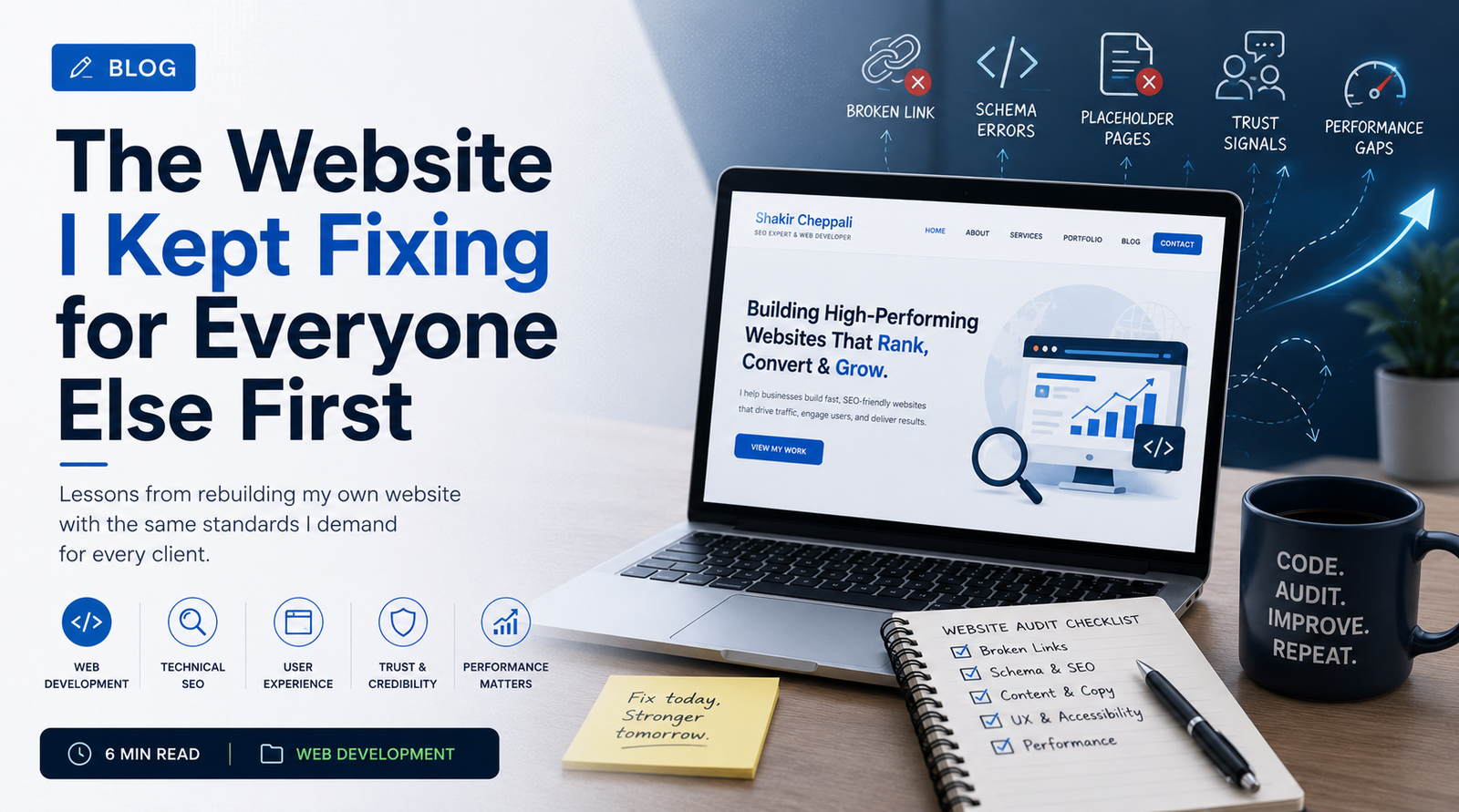
There's a joke in this industry that isn't really a joke: the cobbler's children have no shoes. Ask any developer or designer about their own website, and you'll usually get an awkward laugh before an honest answer. Mine went unfinished for longer than I'd like to admit — not because I didn't know what it needed, but because I always knew exactly what a client's site needed first, and that took priority every single time.
I'd spend a week rebuilding someone else's broken sitemap, patching a competitor's schema errors, or restructuring a resort's booking flow so it actually converted — and my own site sat there, half-implemented, homepage unfinished, waiting for a version of me that had a free afternoon. It's a strange kind of hypocrisy when you make your living telling other businesses their website is costing them customers, while your own has a broken link sitting in the footer.
The Audit I Finally Ran on Myself
Eventually I did to my own site what I do for every client: I stopped being the owner and became the auditor. I opened it up with the same cold, unforgiving checklist I use on a client's homepage, and it was uncomfortable in a very specific way — I couldn't blame a developer who didn't understand the brief, or a content writer who missed the intent. Every gap was mine.
The portfolio CTA link was broken. Not stylistically off — actually broken, routing nowhere, sitting on the page that's supposed to be the strongest proof of my work. My LinkedIn link in the header was dead, pointing at nothing, on a personal brand site where LinkedIn is half the reason people find me in the first place. The Privacy Policy and Terms links were placeholders — the kind of thing you add temporarily and then forget were ever temporary. A testimonial had a grammar error sitting in it, visible to anyone who read closely enough to actually trust it. And the marquee elements — the little scrolling logo or text strips — had duplicated DOM nodes without aria-hidden="true", which meant screen readers were announcing the same content twice, a detail that matters far more than most people realize.
None of these were catastrophic on their own. Together, they told a quiet, cumulative story: this site hasn't had the attention its owner gives to everyone else's.
Why the Small Things Are Never Actually Small
If you've read anything I've written before, you know I don't think of web development as separate from SEO — I think of them as the same discipline wearing different hats. A broken portfolio link isn't just a UX annoyance. It's a trust signal failing in real time, at the exact moment someone was curious enough to click deeper. A dead LinkedIn href isn't just an oversight. It's a closed door on the platform where most of my actual relationships with clients start.
This is the thing I try to get across to every business I audit, and it's the thing I had to relearn on myself: a website doesn't fail because of one dramatic flaw. It fails in inches — a duplicated node here, a placeholder link there, a missing location keyword in the body copy that means the site never quite signals where the business actually operates. Individually, forgivable. Together, they're the reason a visitor's trust quietly drops without them being able to name why.
Rebuilding With the Discipline I Ask of Others
So I did what I tell every client to do: I wrote the punch list, in the same format I'd hand a development team for any paying project. Fix the portfolio CTA. Replace the dead LinkedIn href. Build out real Privacy Policy and Terms pages instead of placeholders. Weave the location keywords naturally into the homepage body copy instead of leaving them implied. Fix the testimonial. Add aria-hidden="true" to the marquee's duplicate nodes so accessibility tools stop double-announcing content.
None of it was glamorous. There's no dramatic redesign story here, no big reveal of a completely new visual identity. It's closer to the work I actually do for most clients — an enterprise-level audit, production-ready content for the pages that matter most, and a homepage that finally says clearly what the site is for, instead of assuming a visitor will figure it out.
What Building It Myself Reminded Me
Working on my own site reminded me why I never separated "SEO person" from "developer" in the first place. You can hand a business a beautifully written audit full of smart recommendations, and if nobody translates that into actual code — actual fixed links, actual schema, actual accessible markup — it's just a well-organized wish list. The value shows up at the point where the diagnosis becomes a commit.
It also reminded me of something less technical: it's easy to be rigorous on someone else's behalf and generous with yourself. Every developer who's ever told a client "this needs to be fixed before launch" has a version of their own site running with three things they've been meaning to get to for months. I don't think that makes anyone a hypocrite. I think it makes the discipline of finishing your own punch list worth talking about honestly, instead of pretending the website you build for yourself doesn't need the same standard you hold everyone else to.
Mine does now. It's still not "finished" — no website ever really is, that's the nature of the thing — but it's finally built the way I'd want a client's to be: honest copy, working links, structured data doing its job quietly in the background, and nothing left as a placeholder pretending to be a real page.
Does your website have its own quiet list of small things nobody's gotten around to fixing?
Let's talk — I'll run the same audit on yours that I ran on my own.
Get a Website AuditShare this article
If you found this helpful, pass it along.