
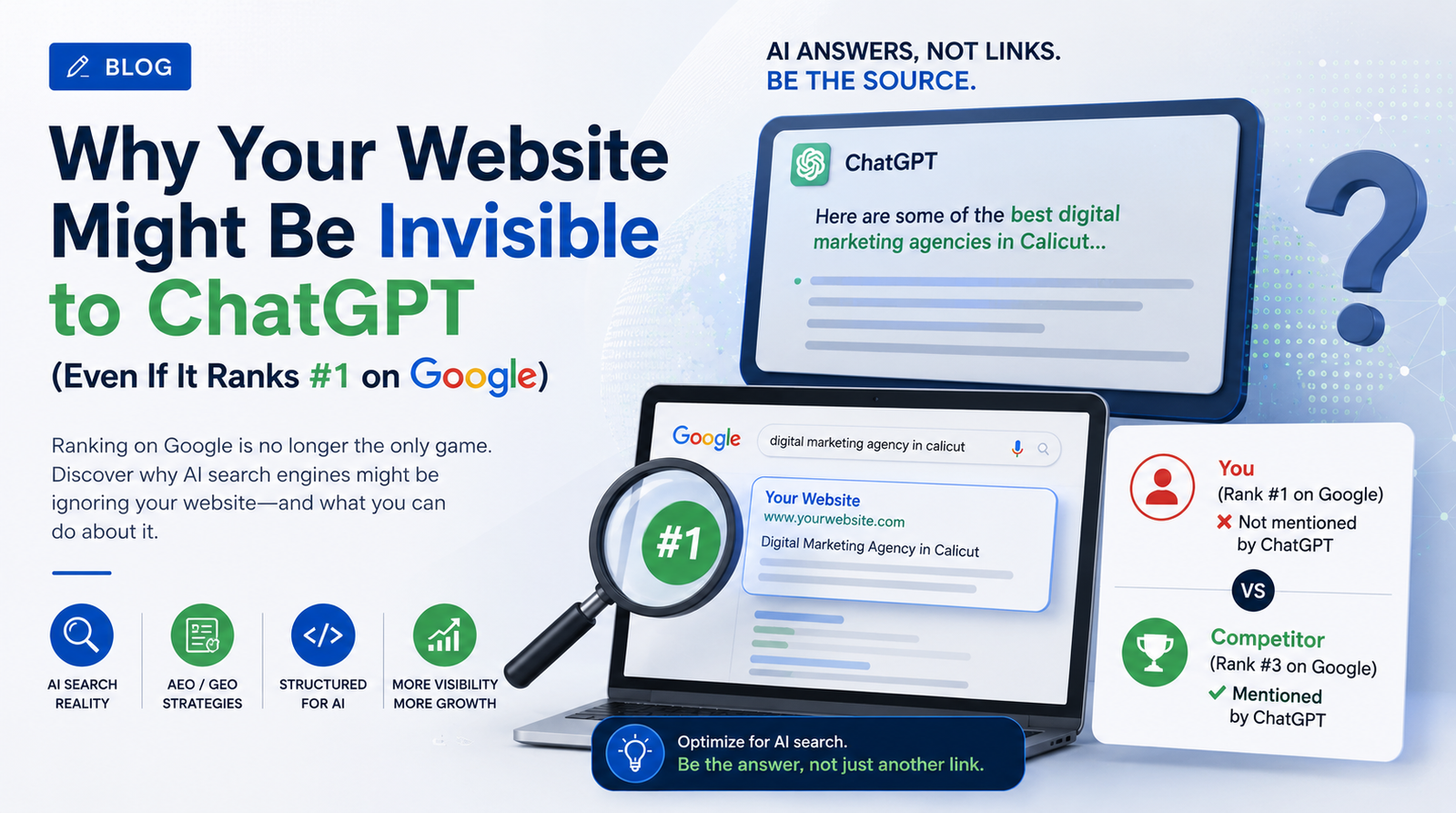
A client came to me a few months ago, confused and a little frustrated. His website held the #1 spot on Google for his main keyword. Traffic from search was steady. By every metric he'd been taught to watch, things were working. And yet when he asked ChatGPT a question his own business could answer perfectly, his site never came up. A competitor — ranked third on Google — did.
That contradiction is becoming one of the most common calls I get. And it points to something most businesses, and honestly most agencies, haven't fully caught up to yet: ranking well on Google and being visible to AI search are no longer the same job.
Two Different Games, Not One
For twenty years, SEO meant one thing: convince Google's crawler that your page deserved to rank, and everything downstream — clicks, traffic, customers — followed from that. That game still matters. But it's no longer the only game.
When someone asks ChatGPT, Perplexity, or Google's AI Overviews a question, the system isn't ranking ten blue links for a human to click through. It's synthesizing an answer from content it trusts enough to pull from directly — often without sending the user to your site at all. This is what people are starting to call AEO, Answer Engine Optimization, and GEO, Generative Engine Optimization. And the content that gets pulled into those answers is often structured completely differently from content that simply ranks well.
I've seen sites that dominate page one of Google and still get skipped entirely by AI Overviews. Not because the business isn't authoritative — but because the page was never built in a way an AI system could confidently extract an answer from.
Structured data isn't decoration. It's the label that tells a machine "this exact sentence is the answer to this exact question." Generative engines rely heavily on clean semantic structure.
What I Actually Found in That Audit
Going back to that client: the diagnosis wasn't about content quality. His writing was genuinely good. The problem was structural, and it was made up of a few very specific gaps.
First, there was no FAQPage schema anywhere on the site. His content answered common customer questions beautifully in flowing paragraphs — exactly the kind of writing that reads well to a human and is genuinely hard for an AI system to cleanly extract a discrete answer from. Structured data isn't decoration. It's the label that tells a machine "this exact sentence is the answer to this exact question."
Second, his key facts — pricing, service areas, turnaround times — were buried mid-paragraph, several sentences deep, wrapped in marketing language. AI systems tend to favor content that states things plainly and early. A generative engine pulling together an answer will reach for the page that says the thing directly, not the page that implies it elegantly.
Third, and this one surprised him the most: his most authoritative page, the one that should have been the obvious source for any AI answer about his industry, had no clear author attribution, no citations, and no schema marking it as a trustworthy entity. To a human reader, expertise came through in tone. To a machine trying to establish trust signals, there was nothing to grab onto.
None of these were content problems. They were structural, code-level gaps — which meant the fix wasn't "write more," it was rebuild the scaffolding around what was already good.
What We Actually Changed
I added FAQPage JSON-LD schema mapped directly to the real questions his customers asked — not guessed questions, ones pulled from his own search query data. I restructured key pages so the direct answer appeared in the first two sentences, with the nuance and elaboration following after, rather than the other way around. And I added Organization and Person schema with clear authorship, tying his expertise to a verifiable entity rather than leaving it as unstructured prose.
None of this touched his Google rankings much — he was already doing well there. What it changed was whether AI systems had anything to reliably grab onto when constructing an answer in his space. That's the part most SEO work still doesn't touch, because most SEO work is still optimized entirely for the crawler, not for the systems now standing between the crawler and the person asking the question.
The Businesses Getting This Wrong Right Now
Most businesses I look at fall into one of two camps. Either they haven't thought about AI search at all, and their content sits there, well-written and completely unstructured for machine extraction. Or they've heard the term "AEO" somewhere and bolted on a generic FAQ section without connecting it to actual schema markup or real customer questions — which does almost nothing.
The businesses that are ahead of this aren't the biggest ones. They're the ones willing to rebuild their content architecture around a simple question: if an AI system needed to answer a question using only this page, could it find a clean, direct, well-labeled answer here? Most pages, when you actually test them that way, fail immediately.
Where This Is Heading
I don't think Google rankings are going away. But I think the assumption that ranking #1 means you're visible is already outdated, and it's going to get more outdated every quarter from here. The businesses that treat AEO and GEO as an afterthought are going to watch competitors who never even beat them on Google start showing up as the answer instead of them.
If you've never actually checked whether ChatGPT or AI Overviews can see your business the way Google can, that's usually the first thing worth finding out — before you spend another rupee or riyal on content built for a search engine that's no longer the only one asking the questions.
Want to know if your site is visible to AI search engines?
Let's talk — I'll show you exactly what's missing.
Get an AI Visibility AuditShare this article
If you found this helpful, pass it along.