
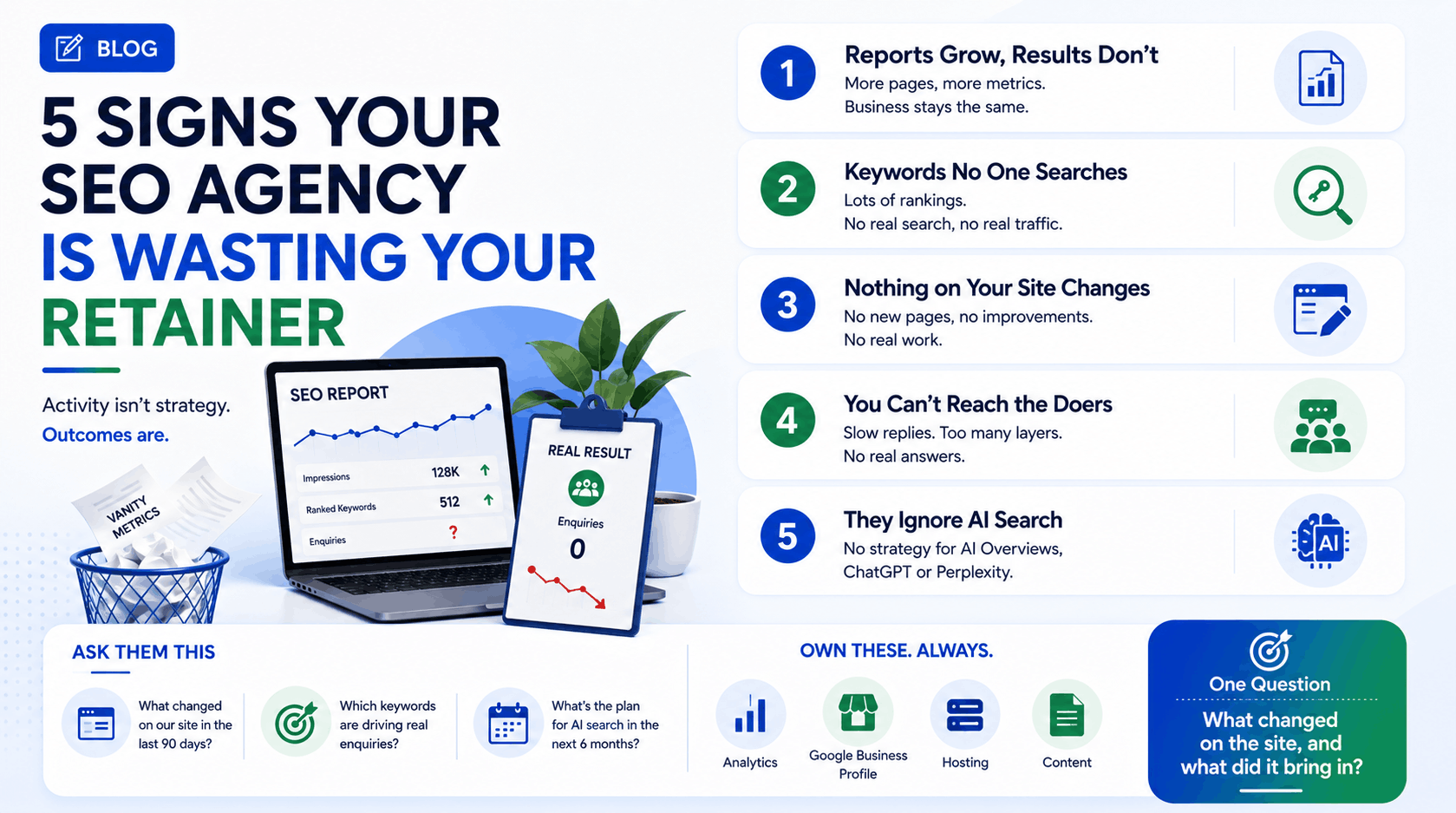
Bad SEO agencies rarely disappear. They send a report every month, they attend the call, they use the vocabulary correctly — and eighteen months later nothing about your business has changed.
I’ve taken over enough accounts mid-contract to recognise the shape of it. The tell is almost never incompetence. It’s a retainer that has quietly become a subscription to activity rather than outcomes.
Five signs, in rough order of how often I encounter them.
1. The Report Grows and the Business Doesn’t
Month one: four pages. Month twelve: twenty-two pages, colour-coded, with a section on impressions. Somewhere in there the report stopped describing your business and started justifying the invoice.
Watch which metrics get promoted over time. Early reports lead with leads and revenue. Later ones lead with impressions, keyword counts, and “visibility scores” — numbers that only move upward and that no one outside the agency can independently check.
Ask one question: how many enquiries came from organic search last month, and how does that compare to the month you signed? If nobody can answer without a week’s notice, that’s the answer.
2. The Ranked Keywords Are Ones Nobody Searches
This one is almost artful. The report shows forty keywords on page one. Genuinely true. Then you read them: your own brand name, your brand name plus “reviews,” your brand name plus your city, and thirty-odd phrases so specific that they carry a handful of searches a month between them.
Ranking for your own brand is not an achievement. You’d rank there anyway. Take the keyword list and mark every term a stranger with a problem and a budget might plausibly type. If that’s a short list, you’re paying for a rankings report, not for customers.
A keyword that ranks #1 and converts nobody is worth less than a keyword that ranks #6 and brings you two clients a month. Position is a proxy. Revenue is the thing.
3. Nothing on Your Website Actually Changes
SEO is work performed on a website. If the site is materially the same as it was six months ago, the work either isn’t happening or isn’t reaching the thing it’s supposed to improve.
This is the easiest sign to verify and almost nobody checks it. Open your site. Can you point at what changed this quarter? New pages, rewritten copy, faster load, restructured navigation, added schema? “We optimised the meta tags” in month nine, on a site that was already indexed, is not a quarter’s work.
4. You Can’t Reach Anyone Who Touches the Site
You speak to an account manager. The account manager speaks to a delivery team. The delivery team may be a contractor two countries away. Every question you ask takes four days and comes back slightly reshaped.
I’ve written about this at length, because it’s the complaint I hear most and the one people feel worst about raising. A layer of translation between you and the person doing the work isn’t automatically bad — large projects need coordination. It’s bad when the layer is the only thing you’re reliably paying for.
The test: ask a specific technical question. “Why is our services page slower than our homepage?” A healthy engagement returns a real answer. An unhealthy one returns a meeting invitation.
5. Nobody Has Mentioned AI Search
This one is new and it’s the fastest-moving signal on the list. If your agency’s strategy in 2026 is identical to their 2022 strategy, they’ve missed a genuine shift in how people find businesses.
Customers now ask ChatGPT, Perplexity and Google’s AI Overviews questions your business could answer, and those systems name a shortlist. Being absent from that shortlist doesn’t show up anywhere in a rankings report — which is precisely why an agency optimising only for rankings can show you a green dashboard while you lose ground.
You don’t need them to have solved it. You need them to have noticed it. If the phrase has never come up in twelve months of calls, ask why.
What to Do Before You Fire Anyone
Give them a fair chance to answer, in writing. Three questions, one email:
- What specifically changed on our website in the last ninety days?
- Which keywords are driving actual enquiries, not impressions?
- What’s the plan for AI search over the next six months?
A good agency answers these in a day, possibly with some justified irritation. A struggling-but-honest one says “we’ve been focused elsewhere, here’s the plan.” That’s recoverable, and worth recovering.
What you’re looking for is defensiveness — a reply that reframes the questions, buries them in vocabulary, or explains that SEO takes time without saying what the time has been spent on. That’s not a communication problem. That’s the answer.
And Before You Sign the Next One
Insist on knowing who does the work and being able to speak to them. Insist on a ninety-day plan with named deliverables. Insist on owning your analytics, your Google Business Profile, your hosting and your content — all of it, in your own accounts.
Then hold the whole thing to a single question, asked every quarter: what changed on the site, and what did it bring in? Everything else is decoration.
If you want a second opinion on what your current retainer is actually delivering, the audit is deliberately independent of hiring me for anything else — you get the document and you can take it wherever you like. Or just send me the reportand I’ll tell you what I see in it.
Share this article
If you found this helpful, pass it along.