
Three acronyms, a lot of people selling all three as separate products, and a fair amount of nonsense in between. Here’s what each one actually means, and which of them your business genuinely needs.
I get asked about this on nearly every discovery call now, usually in the form of “someone told me SEO is dead and I need GEO instead.” SEO is not dead. But something real has changed, and the acronyms are a clumsy attempt to describe it.
The Short Version
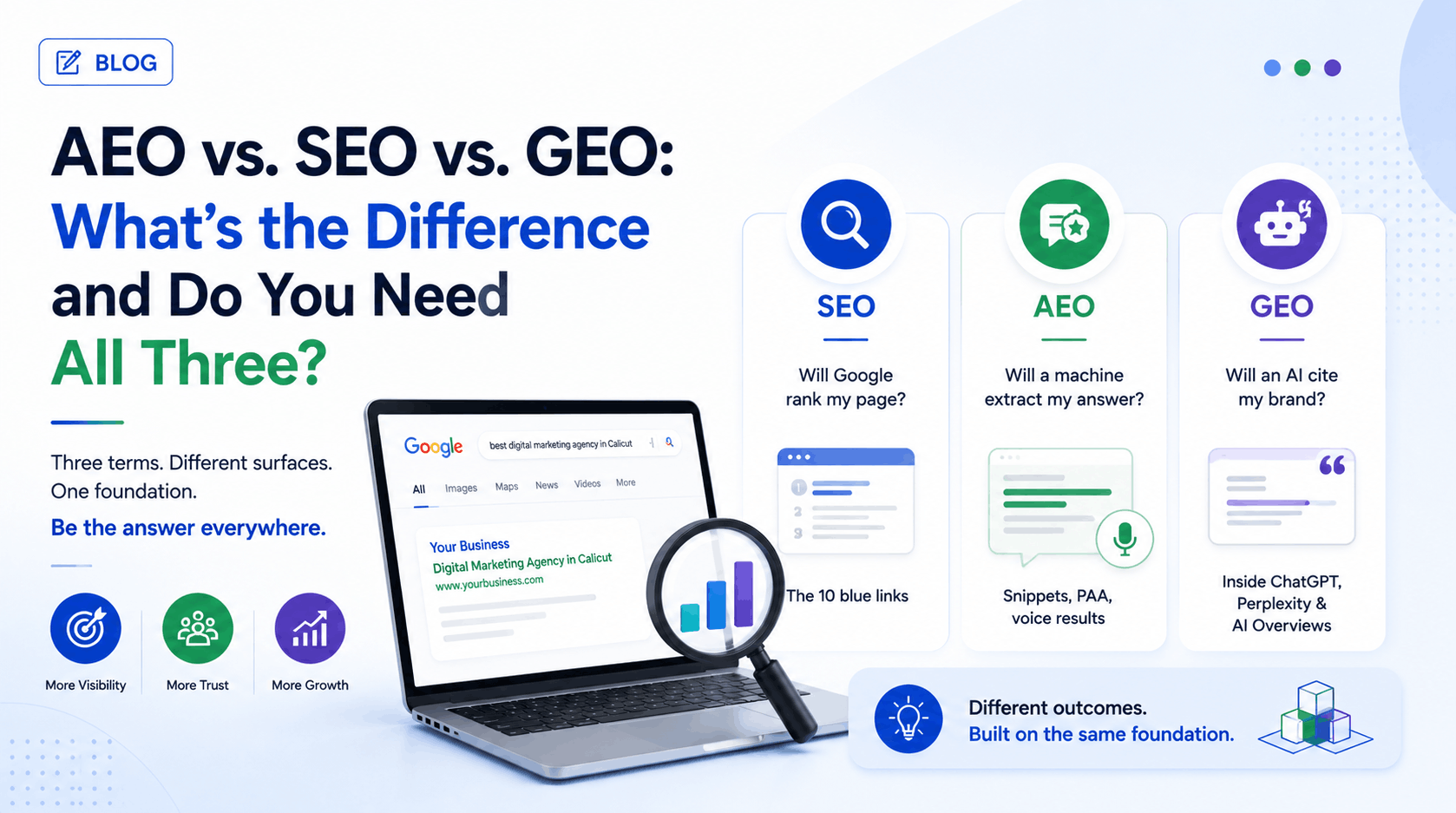
| Term | The question it answers | Where the result appears |
|---|---|---|
| SEO | Will Google rank my page? | The ten blue links |
| AEO | Will a machine extract my answer? | Featured snippets, People Also Ask, voice results |
| GEO | Will an AI cite my brand as a source? | Inside ChatGPT, Perplexity and AI Overview answers |
They are not three competing strategies. They are three different surfaces, and they share most of the same foundation.
SEO: Getting Ranked
Search Engine Optimization is the original discipline and it still pays most of the bills. Crawlable site, sensible architecture, pages that match what people search for, enough authority that Google believes you.
Anyone telling you this no longer matters is selling something. A large share of commercial searches still end in a click on a normal search result, and for local businesses especially, the map pack and the blue links are still where the customers come from.
AEO: Getting Extracted
Answer Engine Optimization is about being the source a machine lifts a direct answer from. Featured snippets, People Also Ask boxes, voice assistants reading a single paragraph aloud.
The mechanics are unglamorous and mostly structural. Ask the question as a heading, in the words a person would use. Answer it in the first forty to sixty words, plainly, before any elaboration. Use FAQPage schema so the boundary between question and answer is machine-readable rather than inferred. Put comparisons in real tables.
The habit that breaks AEO is the one every good marketer is trained into: building to a conclusion. Context, then nuance, then the answer at the end. Extraction systems reach for the page that says the thing immediately. Lead with the answer; keep the nuance underneath it.
GEO: Getting Cited
Generative Engine Optimization is the newest and the most misunderstood. It’s not about ranking or extraction. It’s about whether a generative model, assembling an answer about your industry, treats your business as a source worth naming.
That comes down to entity clarity and corroboration. Is it unambiguous who you are, what you do and where you operate? Is that story consistent everywhere the model has seen you — your site, your profiles, your listings, third-party mentions? Are there specific, checkable facts attached to your name rather than adjectives?
“Leading provider of quality solutions” gives a model nothing. “Freelance SEO consultant in Mukkam, Kozhikode, working with clients across Kerala and the Gulf since 2016” gives it an entity it can resolve, place, and cite.
SEO earns you a position. AEO earns you the answer. GEO earns you the mention. Different outcomes, one foundation — and the foundation is still a well-built, factually specific website.
So Do You Need All Three?
Mostly, you already are doing all three, badly or well, whether or not anyone has invoiced you for it. The honest sequencing looks like this.
If your site is technically broken, start with SEO. There is no point optimising for citation by an AI system that cannot crawl your pages. Slow, unstructured, thin sites fail all three disciplines simultaneously.
If you rank but don’t convert attention, add AEO.This is the cheapest win on the list. Restructuring existing content into question-led, answer-first blocks with proper schema is often a few days of work against content you’ve already paid to produce.
If your customers research before buying, invest in GEO.High-consideration purchases — professional services, B2B, hospitality, anything with a long decision cycle — are exactly where people now open ChatGPT before Google. If you sell impulse items to walk-in traffic, this is genuinely less urgent, and I’d say so.
The Overlap Is the Point
Here’s what the people selling three separate retainers won’t emphasise: the work overlaps heavily. Clear headings help ranking, extraction and citation. Schema helps all three. Fast, crawlable pages help all three. Specific facts stated plainly help all three.
Genuinely GEO-specific work — entity consistency across the web, corroboration, monitoring how models describe you — is maybe twenty percent on top of a solid SEO foundation. Anyone quoting three full retainers for three acronyms is charging you three times for one job.
I’ve written before about a client who ranked #1 and was still invisible to ChatGPT. Fixing that took schema, restructured answers and clear authorship. It was one project, not three.
Where to Start
Take your five most commercially important pages and ask three questions of each. Does it rank? Does it answer its central question in the first two sentences? Would a machine reading it come away with checkable facts and a clear sense of who published it?
Most businesses find they pass the first and fail the other two. That’s a content structure problem, not a budget problem — and it’s fixable without a new website.
If you want to know where you stand, the AEO & GEO service page covers how I approach it, or just ask meand I’ll give you a straight answer about which of the three you actually need first.
Share this article
If you found this helpful, pass it along.