
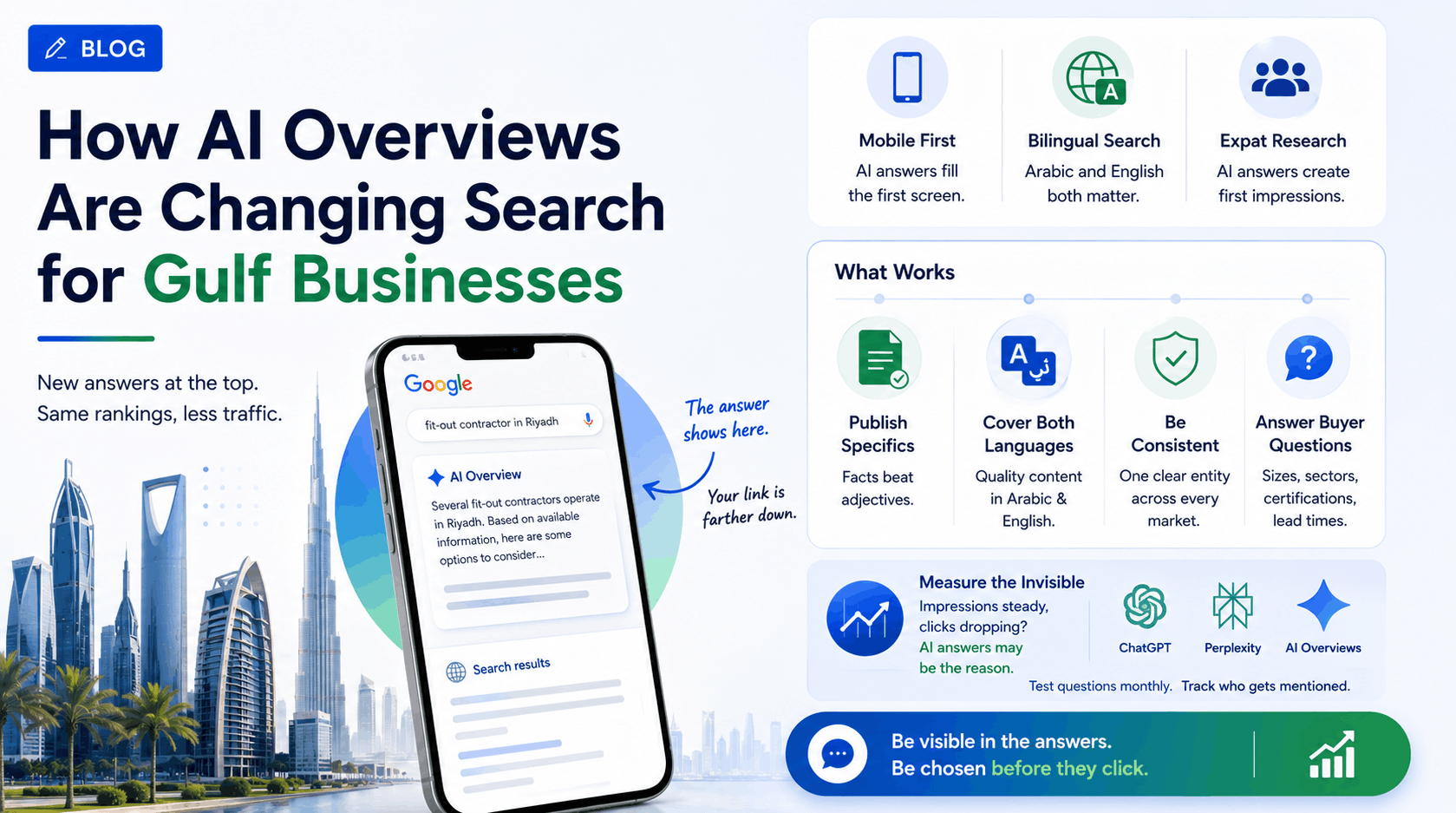
A contracting client in Riyadh told me his enquiries had dropped while his rankings hadn’t moved at all. Both things were true. That combination is becoming the defining search problem for Gulf businesses.
I work with clients across Qatar, the UAE and Saudi Arabia alongside Kerala, and the pattern in those markets is arriving faster and hitting harder than it is at home. Worth understanding why.
The Position You Hold Is Not the Traffic You Get
When Google answers a question directly at the top of the page, the result underneath it can hold its position and still lose the click. Nothing about your ranking changed. What changed is how much of the page sits above you, and whether the searcher got what they needed before reaching you.
For informational queries — “what is a fit-out contractor,” “how does cold chain logistics work” — this hits hardest. For high-intent commercial queries, less so; people still click when they’re ready to buy. The businesses feeling it worst are the ones whose traffic was mostly top-of-funnel explanation.
Why the Gulf Is Different
Three things make these markets move faster than Kerala.
Mobile-first, at extreme levels. A very large share of search across the GCC happens on phones, where an AI answer occupies effectively the entire first screen. On desktop you scroll past it. On a phone it is the page.
Bilingual search behaviour. Customers switch between Arabic and English within the same research session, often on the same question. Businesses publishing only in English are invisible for half of it, and AI answers are perfectly happy to synthesise across both languages — pulling from whichever source is clearer, in either language.
Expatriate research patterns.Someone newly arrived in Doha or Dubai has no local word-of-mouth network. They ask a machine. That user has no prior brand preference at all, which means the answer they receive isn’t competing with their existing knowledge — it’s creating it.
In markets with heavy expatriate populations, an AI answer is often a customer’s first and only impression of your category. Being absent from it isn’t lost traffic — it’s never having existed.
What Changes for Gulf B2B
Most of my Gulf work is B2B — contracting, fit-out, logistics — and the shift there is subtler than in consumer markets. Procurement teams still run formal processes. But the shortlist that enters those processes increasingly gets assembled by someone asking an assistant “who does industrial fit-out in Riyadh” and writing down the names it returns.
You don’t lose the tender because your proposal was weak. You lose it because you were never on the list of firms to invite. That failure is invisible in your analytics — there is no line in Search Console for “times you weren’t mentioned.”
What Actually Works
Publish specifics, not adjectives.Project scale, sectors served, cities covered, certifications held, timelines you actually meet. Generative systems reach for checkable facts and skip past “leading provider of world-class solutions.” The case studies on this site work partly because they name real outcomes rather than describing excellence in general.
Cover both languages properly. Not machine-translated pages, which read as low-quality to systems and humans alike, but genuinely written Arabic content with correct hreflang. This is the single biggest structural gap I see in the region.
Be consistent across every market.If your Saudi entity, your UAE entity and your head office describe the business three different ways, you’ve given the model three weak entities instead of one strong one. Same name, same description, same facts, everywhere.
Answer procurement questions on your site. Minimum project size, sectors, lead times, licensing. These are exactly the questions buyers ask assistants, and most company sites answer none of them.
Measuring Something You Can’t See
Standard analytics won’t show this. Impressions holding steady while clicks fall is the clearest signal you have — that gap is usually the answer box taking the click.
Beyond that, ask the assistants directly. Query ChatGPT, Perplexity and Google’s AI Overviews with the questions your customers ask, in both languages, and record who gets named. Do it monthly. It’s crude, and it’s the most honest competitive intelligence available right now.
The Practical Read
Nothing here means abandoning SEO. Rankings still matter, and for commercial-intent searches they matter enormously. What’s changed is that ranking is no longer sufficient on its own — you also need to be legible to the layer that now sits between the search and the searcher.
For Gulf businesses the timing is the real point. These markets are further along this curve than most, which cuts both ways: the risk is arriving late, and the opportunity is that most of your competitors already have. If you want to know how your business is currently described by AI systems, get in touch— it’s usually the first thing I check.
Share this article
If you found this helpful, pass it along.