
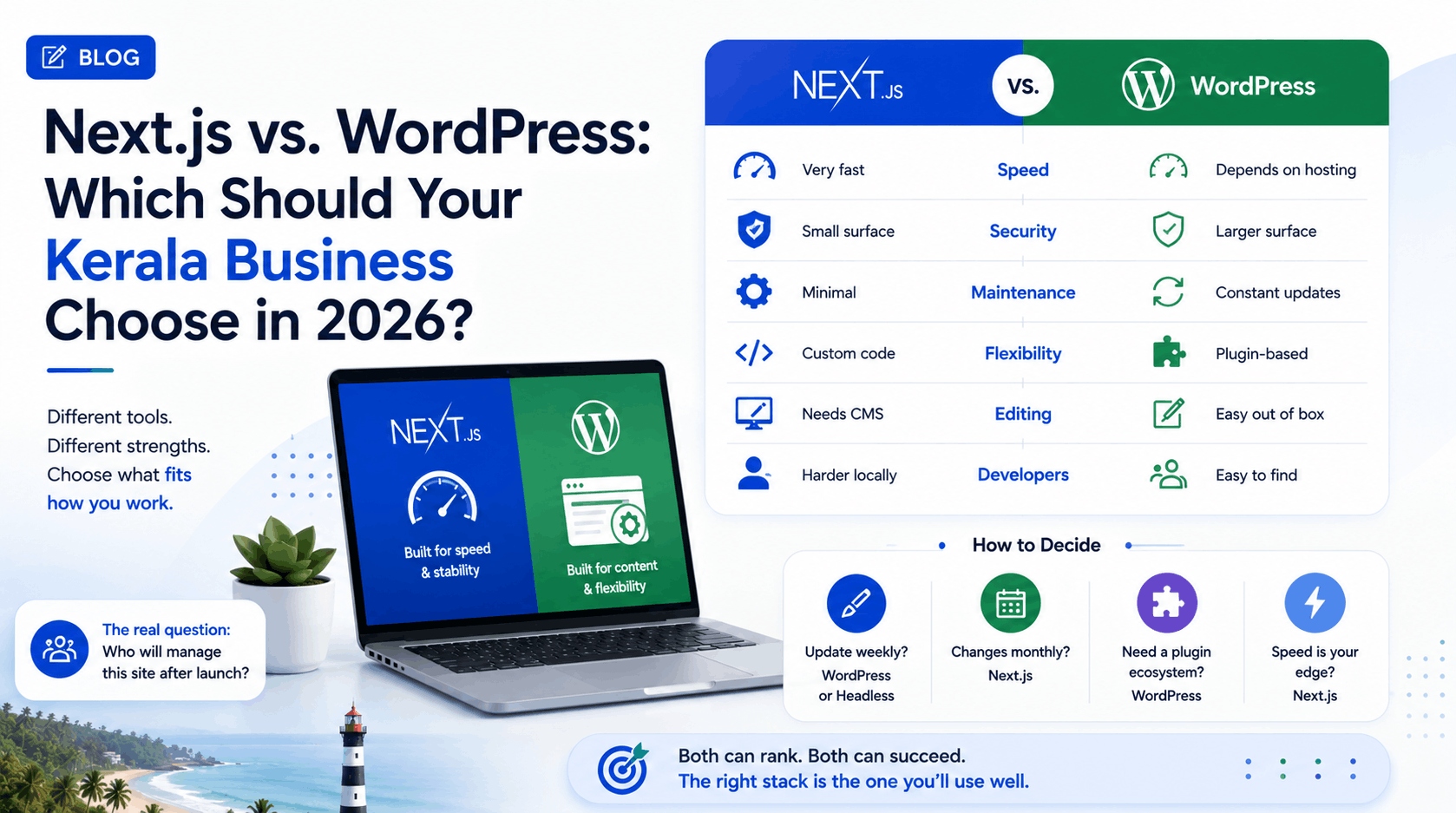
I build in both, which means I have no particular stake in winning this argument. What I do have is a fairly reliable sense of which businesses regret which choice, and it comes down to one question that has nothing to do with technology.
The question is: who is going to touch this site after launch?
Answer that honestly and the decision mostly makes itself. Answer it aspirationally — “we’ll definitely be publishing weekly” — and you end up with the wrong stack and an expensive lesson.
What Each One Is Actually Good At
| WordPress | Next.js | |
|---|---|---|
| Editing without a developer | Excellent | Needs a CMS bolted on |
| Speed out of the box | Depends heavily on hosting and plugins | Very fast by default |
| Ongoing maintenance | Constant — core, themes, plugins | Minimal |
| Security exposure | Large surface, plugin-driven | Small surface |
| Custom functionality | Plugin-shaped | Anything you can code |
| Finding another developer later | Easy anywhere | Harder locally |
That last row matters more than developers like to admit, and I’ll come back to it.
Choose WordPress If Content Is the Product
If your site lives or dies on publishing — a news operation, a resort updating packages and seasonal offers, a business with someone in-house who genuinely writes every week — WordPress earns its keep. The editing experience is familiar, you can hire help anywhere in Kerala, and the ecosystem has a plugin for nearly everything.
The cost is maintenance. Plugins update, break, conflict and occasionally get abandoned. WordPress’s market share makes it the most attacked platform on the web. That’s survivable with decent hosting and someone paying attention, but “someone paying attention” is a recurring cost, not a one-off.
Choose Next.js If Speed and Stability Matter More Than Daily Edits
If your site is essentially a very good brochure that changes monthly rather than daily — a service business, a contracting firm, a professional practice — Next.js gives you a faster site with a fraction of the ongoing surface area.
Pages render fast because they’re prebuilt. There are no plugins to patch. You control the markup completely, which matters more than it used to: structured data, clean heading hierarchies and answer-shaped content are easier to get exactly right when nothing is generating your HTML for you.
This site runs on it, for exactly those reasons. That’s a bias I’m declaring, not hiding.
Both platforms rank perfectly well. Google does not award points for your framework. What it notices is speed, structure and crawlability — and either stack can deliver or destroy all three depending on how it’s built.
The SEO Question, Settled
“Which is better for SEO” is the wrong question and it’s asked constantly. A well-built WordPress site beats a badly-built Next.js site every time, and the reverse is equally true.
What actually decides it is what happens in practice. WordPress sites tend to accumulate plugins, and plugins tend to accumulate scripts, and by year two the site loads in six seconds on mobile data. Next.js sites tend to stay fast because there’s less that can go wrong unattended. That’s a tendency, not a law — I’ve seen disciplined WordPress builds stay quick for years.
The Argument Against My Own Preference
Here is the honest downside of Next.js for a Kerala business: the local hiring pool is smaller. If we stop working together, you can find a WordPress developer in Kozhikode this afternoon. Finding a React developer takes longer and costs more.
For some businesses that risk outweighs the performance benefit, and when it does I say so and build WordPress. A site nobody can maintain is worse than a slightly slower site with a queue of people who can.
The Middle Path
You can have both: Next.js on the front end for speed and control, with a headless CMS behind it so non-technical staff still edit content in a friendly interface. It costs more up front and it’s the right answer less often than its advocates suggest, but for a business that genuinely publishes often and genuinely needs speed, it resolves the tension properly.
How I’d Decide in Five Minutes
Will someone non-technical update this weekly? WordPress, or headless. Is it a marketing site that changes a few times a month? Next.js. Do you need a specific plugin ecosystem — a particular booking system, a membership tool? WordPress, and don’t fight it. Is raw speed a competitive advantage in your market? Next.js.
What shouldn’t decide it: what your cousin uses, what’s trending, or what your developer happens to prefer. Including me — I’ll recommend the stack that fits how you’ll actually work, and I’d rather have that conversation before quoting than after building. Here’s how I approach builds, either way.
Share this article
If you found this helpful, pass it along.