
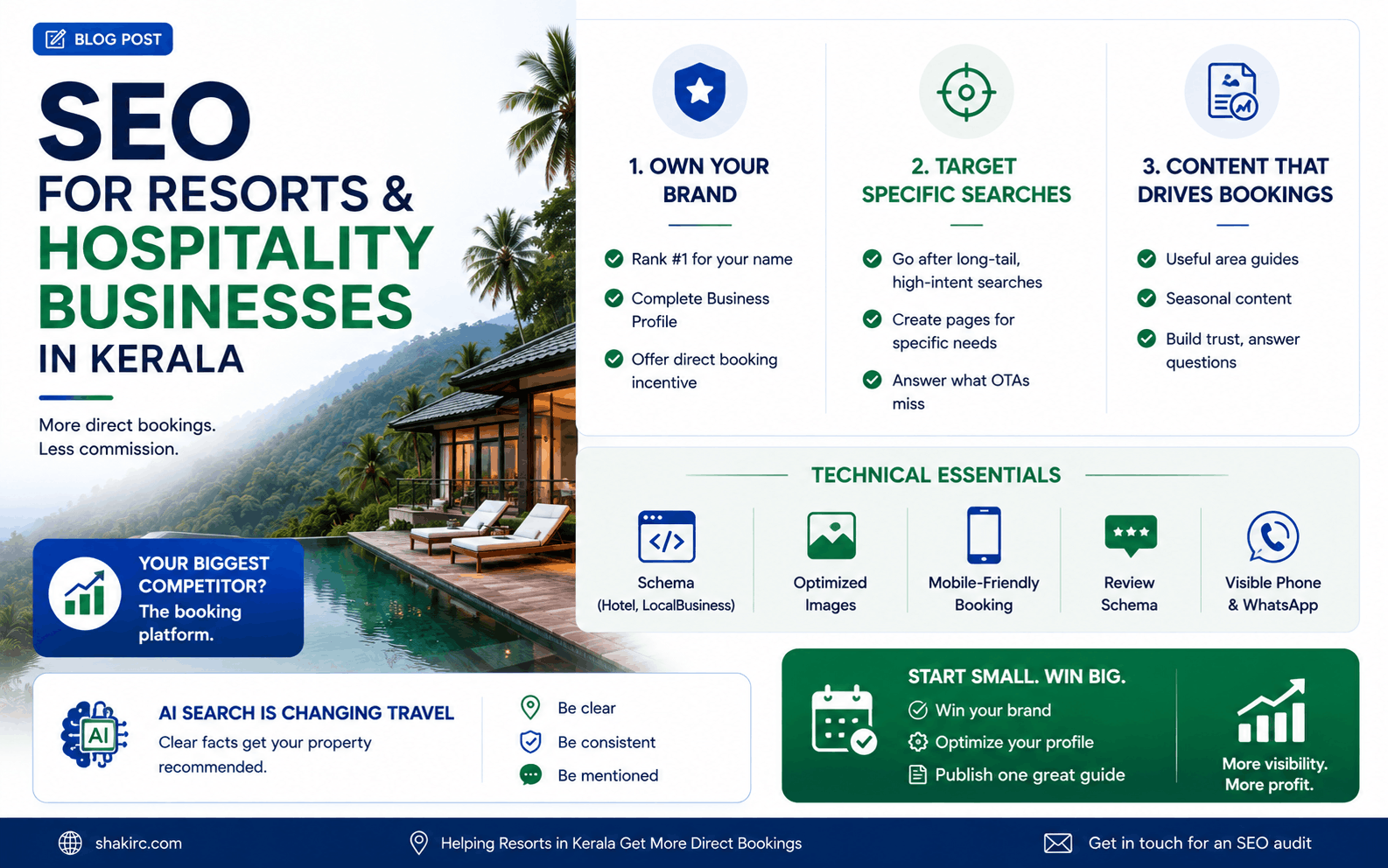
Hospitality is the only sector I work in where the client’s biggest competitor isn’t another business — it’s the booking platform taking fifteen to twenty-five percent of every reservation the client could have taken directly.
I’ve worked on resort and hotel properties in Kerala, including Lapace Villa Resort in Kakkadampoyil and Miracle Resort in Calicut. The problems repeat with unusual consistency, and so do the fixes.
The Structural Problem
Search “resorts in Wayanad.” Count how far you scroll before you reach a resort’s own website rather than an aggregator. That’s the market you’re competing in.
You will not out-rank the major OTAs on generic head terms. They have more authority, more content and more budget than any single property in Kerala, and pretending otherwise is how hospitality marketing budgets get burned. The winnable game is different: own your brand name completely, own the specific searches the platforms handle badly, and convert the traffic you do get at a much higher rate.
Start by Winning Your Own Name
Here is the highest-value hour in resort SEO. Search your property name. If an OTA listing ranks above your own site, or an OTA is bidding on your name, you are paying commission on guests who were already looking specifically for you.
These are people at the very bottom of the funnel with intent to book you. Losing them to an intermediary is the most expensive avoidable leak in the business, and it’s usually fixable with a properly optimised brand page, a complete and verified Business Profile, and a direct-booking offer that beats the platform price.
The last part matters. If your direct rate is identical to the OTA rate, the guest has no reason to leave the platform. Give them one — a free breakfast, a late checkout, a modest discount. Anything below the commission you’re currently paying is profit.
Every direct booking you win from an OTA is not incremental revenue — it’s recovered margin on revenue you were already earning. That makes brand-term SEO the highest-return work available to a resort.
Compete on Specificity, Not Volume
The OTAs are excellent at “hotels in Kerala.” They are noticeably weaker at the long, particular questions real travellers actually ask.
“Resorts near Kakkadampoyil with a private pool.” “Family-friendly resorts two hours from Calicut airport.” “Places to stay in Wayanad during monsoon.” These have lower volume, far higher intent, and are answered badly by a platform whose page is a filtered list rather than a description of anywhere.
A property that publishes a genuinely useful page about monsoon travel in its own region — what’s open, what’s beautiful then, what to bring — wins searches no aggregator is really trying to win.
Content That Earns Bookings
The single most under-built asset in Kerala hospitality is the area guide. Not a paragraph titled “Attractions Nearby” listing five places with no detail — an actual guide with distances, travel times, seasons, and honest recommendations.
It does three jobs at once. It ranks for searches about the destination rather than about accommodation, which is what people search first. It answers the questions that stall a booking decision. And it demonstrates that you know your own region, which is the entire reason someone chooses an independent property over a chain.
Write the seasonal pieces too. Monsoon, peak, festival periods. Kerala tourism is intensely seasonal and search demand shifts months ahead of arrivals — publish before the season, not during it.
The Technical Layer That Actually Matters Here
- Hotel and LocalBusiness schema with amenities, check-in times and coordinates, so your property is machine-readable as a property rather than as prose.
- Real photographs, compressed properly. Hospitality sites are image-heavy by nature and this is where they lose mobile speed. Uncompressed hero images are the most common cause of a slow resort site.
- Mobile booking flow. Most leisure browsing happens on a phone. If the enquiry form is awkward on mobile, nothing upstream matters.
- Review schema where it applies, so ratings can appear in results.
- A visible, immediate phone number. A meaningful share of resort bookings in Kerala still happen by call or WhatsApp. Don’t bury it.
The AI Search Shift Is Bigger Here Than Elsewhere
Travel planning has moved to assistants faster than almost any other category. “Plan a four-day trip to Wayanad with a family” is a question people now ask a machine, and the machine names specific properties.
What gets a property named is not marketing language. It’s facts stated plainly and consistently: where you are, what you offer, what it costs, what’s nearby, who you suit. A page saying “an unforgettable escape into nature’s embrace” gives a model nothing to work with. A page saying “twelve villas in Kakkadampoyil, 60 km from Kozhikode, private pools, suited to families and couples” gives it everything.
This is the same discipline I’ve described for AEO and GEO generally, and hospitality is where it pays off fastest — because travel questions are exactly the open-ended, multi-constraint queries assistants handle best.
Where I’d Start
If you run a property in Kerala and want the shortest path to results: win your brand name, fix your Business Profile, add a direct-booking incentive, and publish one genuinely good area guide. That’s a month of focused work and it addresses the largest, most expensive leak first.
Everything after that — seasonal content, schema, the long-tail pages — compounds on top of a property that is finally capturing the guests who were already looking for it.
If you’d like to see how this played out on a real property, the Lapace case study walks through it. Or get in touchand I’ll take a look at where your bookings are currently going.
Share this article
If you found this helpful, pass it along.